A story from my own family
How I found my grandmother's lost brother
My grandmother only ever said she had a brother who went to South America. The records took me from a birth register in Białystok to a grave in Porto Alegre.
By Michael S
My grandmother Mira didn't say much about the family she grew up in. They came from Wasilków and Białystok, in what is now north-east Poland. Of everything she might have told us, one detail stuck: she had a brother who went to South America.
That was it. No name I could be sure of, no country, no year. For most of my life he was a sentence, not a person.
When I started researching my own family properly, he was the one I most wanted to find. Was he real? And if he was, what happened to him?
A boy in the Białystok register
The Jewish civil registers for Białystok from the 1890s are online, scanned page by page. They're written in Russian cursive, in narrow columns, by clerks with their own ideas about spelling. You read them slowly.
In the births for 1895 I found act number 655. A boy named Chaim, born on 31 October 1895, son of Mendel, a townsman of Wasilków, and his wife Masha. The family surname was right there too. Mendel and Masha were the parents my grandmother named.
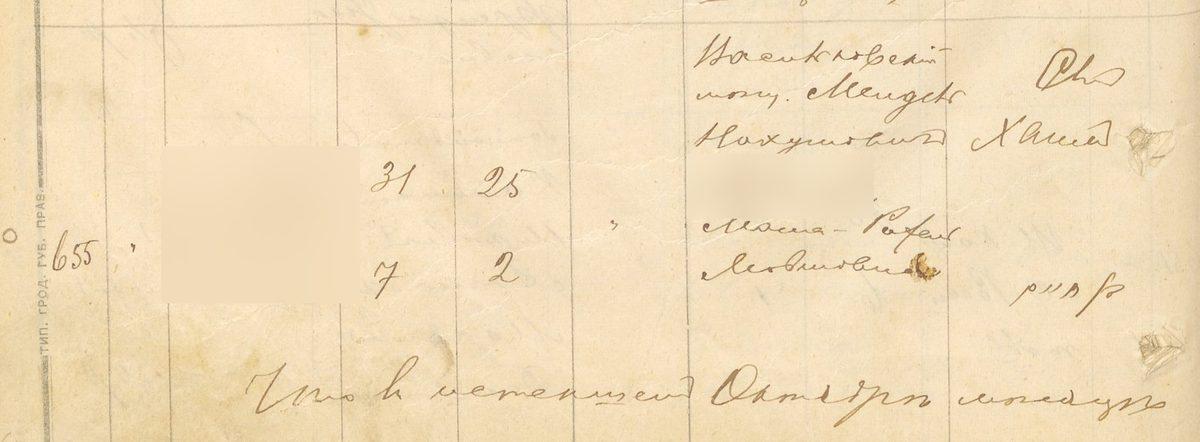
Act 655 in the 1895 Jewish birth register of Białystok: Chaim, born 31 October 1895, son of Mendel, a townsman of Wasilków, and Masha. Surnames are blurred.
Source: Archiwum Państwowe w Białymstoku (State Archive in Białystok), Jewish civil registers, births 1895.
Finding him there was the easy part. A Chaim from Białystok with that surname is not rare. To follow him across an ocean I needed something that joined the boy in that register to a man in South America.
A ship in 1926
Argentina was the first place to look. CEMLA, Argentina's migration records centre, has an online search of people who arrived by sea.
I searched the family surname for people born in Białystok. On 18 August 1926 a ship called the Almanzora reached Buenos Aires from Cherbourg. On board were Sara, a married woman from Białystok with the same surname, and two little girls, Szejna and Jenta. That was Chaim's wife and their daughters.

Chaim's wife Sara with their daughters Szejna and Jenta, all born in Białystok, arriving in Buenos Aires on the Almanzora on 18 August 1926. CEMLA lists Sara twice. The blurred top row is a different person.
Source: CEMLA (Centro de Estudios Migratorios Latinoamericanos), arrivals search.
Chaim himself isn't on that sailing. I still don't know exactly how or when he got to South America, and I'm not going to guess.
One daughter's burial card
A passenger list gives you names and then goes quiet. The next place I looked was the AMIA virtual cemetery, the burial records of the Jewish community of Buenos Aires.
There was a card for a Yenta with the family surname, followed by "de" and another surname. In Spanish, "de" before a surname usually marks a married woman, so this was a Yenta born into the family who had married. She was born in 1923, which fits the little Jenta on the Almanzora.
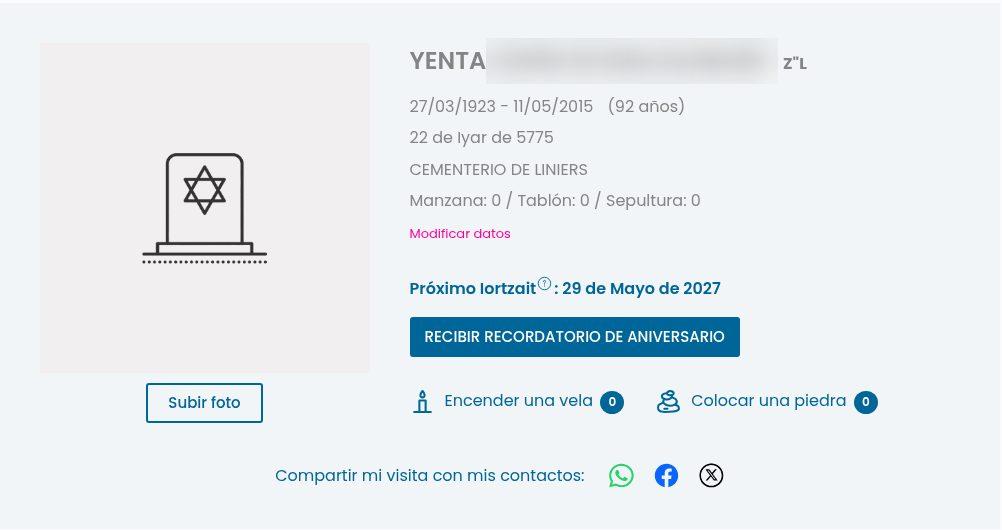
The AMIA burial card for his daughter Yenta, born 27 March 1923. Surnames are blurred.
Source: AMIA Comunidad Judía, Cementerio Virtual, Buenos Aires.
A burial card is a small thing. But it gave me a married surname to search, and that led me to one daughter's family in Argentina.
Jaime, in Porto Alegre
The surprise was where Chaim ended up. Not Buenos Aires, but Porto Alegre, in the south of Brazil.
I wrote to the Centro Israelita Portoalegrense, the city's Jewish community centre, and asked whether they had anything on him. They sent back his death certificate from 1965. He was registered as Jaime, a tailor, born in Poland. He had lived out his life there under a first name I hadn't been searching for.
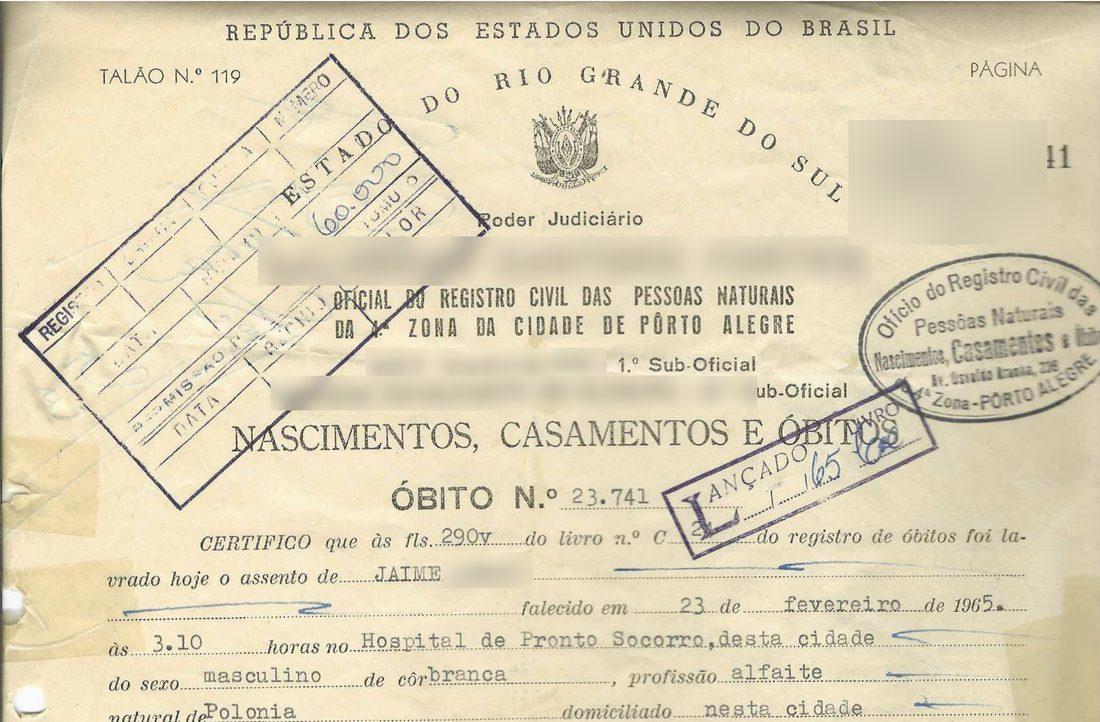
The top of his death certificate, with surnames blurred: Jaime, tailor, born in Poland, died in Porto Alegre on 23 February 1965.
Source: Registro Civil das Pessoas Naturais, 1.a Zona, Porto Alegre. Copy sent by the Centro Israelita Portoalegrense.
A few days later they sent photos of his grave in the Jewish cemetery.
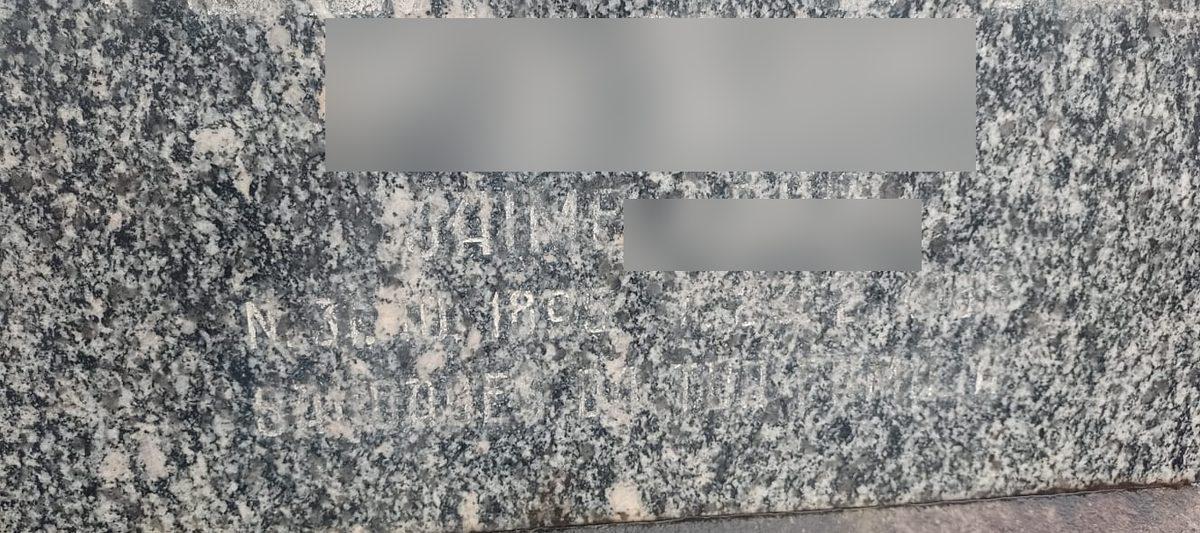
His headstone in the Jewish cemetery in Porto Alegre. The lettering is worn, and the surname is blurred here.
Photo: courtesy of the Centro Israelita Portoalegrense, 2026.
I looked at that photo for a long time. My grandmother's brother, who for my whole life had been one line in a story, had a headstone, a trade and a family.
What happened next
Since then I've been in touch with Chaim's descendants in Argentina and Brazil. We're planning video calls. When I started, I didn't expect to be writing that.
What I still don't know
I want to be plain about the gaps, because that's part of doing this properly. I don't know how Chaim himself reached South America, or when. I've seen more than one version of Sara's maiden name, and I can't yet say which is right. Both stay open until a record settles them.
Why I'm telling you this
Most of this was online: the register scans, the passenger search, the burial card. The rest came from a polite email to the right community office. What it took was time. Reading Russian handwriting, trying the spellings a clerk might have used, and not stopping at the first dead end. Search tools helped me move quickly, and then I checked every source myself before I believed any of it.
That's what Untold Kin does. You bring one question, the kind your family has carried for years. We search the online records, I check every source by hand, and you get a short brief with a link for each claim.
If you have a lost relative of your own, start with your question here.
Mick
Michael S, Untold Kin
Living relatives are not named in this story, to respect their privacy. Record images are shown with their sources.